
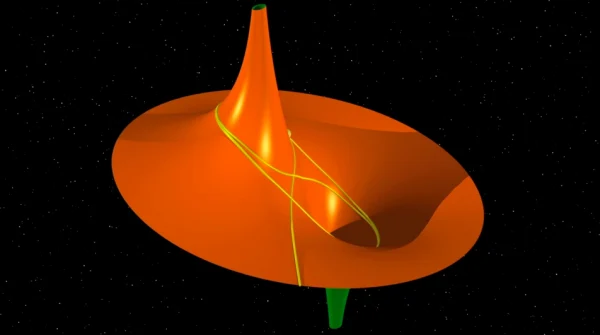

Everyone knows the shortest path between point A and point B is a straight line, but what if you live on a cube, on a sphere, or in a strangely curved space? What if you need to go from point A to point B but need to stop by a river on your way there, or perhaps cross it? How can we always win at billiards by curving the table, and how can we figure out where a complicated shot will go after many bounces? How many times will a beam of light bounce between two mirrors at an angle, and what does that have to do with collisions of massive blocks? Why can we lasso and climb to the top of a mountain that's pointy enough, and how pointy is pointy enough? How can a train travel from New York to Los Angeles in 15 minutes and spend no energy to do so?
Find out the answers to all of these questions and more by relating them all to finding the shortest path between point A and point B! This semilab will cover concepts in Euclidean and non-Euclidean geometry and relate a few of them to extremely theoretical problems in physics.